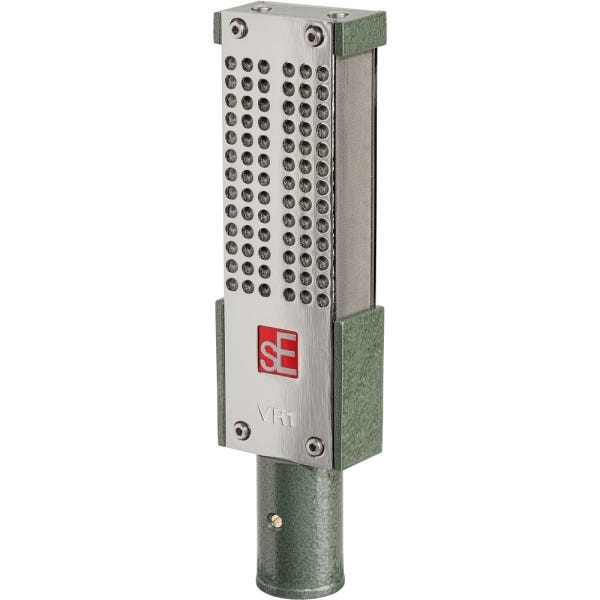
Passive Ribbon Microphone, No Phantom Power Required, Figure-8 Polar Pattern, 2.5-Micron Hand-Crafted Aluminum Ribbon, Patented Mechanical Diffusor, Extended Ribbon Response, 135 dB Max SPL, Phantom-Protected Circuit, 3-Pin XLR Output
This product includes a 1 year SE Electronics manufacturer's warranty that can be extended to 3 years upon registering the products. Coverage: Se Electronics will, at its option, repair or replace the product covered by this warranty if it becomes defective, malfunctions or otherwise fails to conform with this warranty under normal use and service during the term of this warranty, without charge for labor or materials.
The sE Electronics Voodoo VR1 is a passive ribbon microphone built around a hand-crafted 2.5-micron aluminum ribbon and a patented mechanical diffusor that extends its response far beyond a typical ribbon. It needs no phantom power to operate, delivering the smooth, warm, natural character ribbons are loved for while reaching a high-frequency openness passive ribbons rarely achieve. With a figure-8 pattern and 135 dB of maximum SPL, it thrives on loud, bright sources like guitar cabinets and brass. This is the ribbon that tames harsh top end while keeping detail, a microphone you keep close whenever a source needs smoothing.
The VR1 is a passive ribbon microphone, generating its signal directly from the ribbon element with no internal amplifier and no need for 48V phantom power. A ribbon transducer is a thin corrugated strip of aluminum suspended in a magnetic field, and as sound moves the ribbon it induces a small voltage that becomes your signal, a simple design known for its natural, uncolored sound. Because it is passive, the VR1 pairs best with a preamp that offers ample clean gain, and while it is phantom-protected against accidental power, you should still take care with your routing. This straightforward design is a large part of why passive ribbons sound so organic and effortless on the right source.
The VR1's signature feature is a novel mechanical diffusor built into the capsule, a physical structure sE patented to extend the microphone's response. Traditional ribbons roll off in the top octave because the mass of the ribbon limits its high-frequency movement, which is why classic ribbons sound dark; the diffusor works acoustically to control and extend that response. sE marketed the VR1 as the first passive ribbon to approach a full 20 Hz to 20 kHz range within a few decibels, an unusual reach for the type. On cymbals or an acoustic guitar, this extended top end preserves air and detail that older ribbons would lose.
At the core of the VR1 is a hand-crafted aluminum ribbon just 2.5 microns thick. The extreme thinness of the ribbon lets it move freely with the air, giving ribbons their characteristic smooth, fast, and natural response with none of the resonant peaks that make some microphones sound harsh. Because the ribbon responds to air velocity from both sides, it naturally forms a figure-8 pattern. On sources that can turn strident, such as a bright guitar amp or a trumpet, this ribbon delivers a rich, rounded tone that flatters the instrument rather than sharpening its edges.
The VR1 has a native figure-8 (bidirectional) pattern, picking up equally from the front and rear while rejecting sound from the sides. Those deep side nulls let you aim the microphone to exclude a nearby instrument or a reflective surface, and they make the VR1 a natural component in classic stereo techniques. Combined with another figure-8 or a cardioid mic, it enables Blumlein and mid-side recording for a wide, realistic stereo image. On a guitar cabinet, you can even use the rear lobe to capture room reflections or angle the nulls to control bleed.
The VR1 handles up to 135 dB of maximum SPL, giving it the headroom to sit right in front of loud, high-energy sources. Maximum SPL is the loudest level a microphone accepts before distortion becomes significant, and older ribbons were sometimes fragile, but the VR1's 135 dB rating means it stays clean and composed on a cranked amplifier or a blaring brass section. This durability, combined with the ribbon's natural high-frequency smoothing, is exactly why engineers reach for ribbons on aggressive electric guitar. You can place the VR1 close to a roaring cabinet and trust it to deliver a full, controlled tone.
The VR1 is at its best on electric guitar cabinets, brass, drum overheads and room, strings, woodwind, and broadcast or voice-over work where a smooth, vintage-style ribbon tone is wanted. If this is your first ribbon, the diffusor's extended top end means you get classic ribbon warmth without the excessive darkness that can make older ribbons frustrating. If you already own bright condensers, adding the VR1 gives you a complementary voice that smooths harsh sources and adds richness. And for any engineer chasing that effortless ribbon character on guitars and horns, the passive VR1 delivers it with a modern, usable high end.
| MPN | VR1-U |
|---|---|
| Color | Silver |
| Element | Ribbon |
| Pattern | Figure-8 |
| Power Source | Passive |
| Form | Ribbon |
| Output | XLR |
| Channels | Mono |
| UPC / EAN | 819032011096 |
| Brand | Se Electronics |
| Product Condition | New |
| Availability | Out of Stock |

| Microphone Type | Passive Ribbon (Phantom-Protected) |
| Ribbon Element | 2.5-Micron Hand-Crafted Aluminum |
| Polar Pattern | Figure-8 |
| Frequency Range | 20 Hz – 18 kHz |
| Sensitivity | 1.8 mV/Pa (-55 dBV) |
| Impedance | 300 Ω |
| Max SPL | 135 dB (0.5% THD @ 1 kHz) |
| Equivalent Noise Level | 19 dB |
| Signal-to-Noise Ratio | 75 dB |
| Design | Patented Mechanical Diffusor for Extended Response |
| Powering | Passive – No Phantom Power Required |
| Output Connector | 3-Pin XLR (Male) |