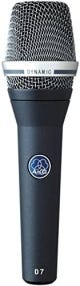
Reference Supercardioid Dynamic Vocal Microphone, Dual-Thickness Varimotion Diaphragm, 70 Hz to 20 kHz, Always-Active 80 Hz High-Pass, Integrated Humbucking Coil, 147 dB SPL at 1 Percent THD, 18 dB-A Equivalent Noise, No On/Off Switch
The AKG D7 is a reference supercardioid dynamic vocal microphone with a dual-thickness Varimotion diaphragm, covering 70 Hz to 20,000 Hz at a sensitivity of 2.6 mV/Pa. Its design brief is unusual and specific: to produce the subtle, open sound of a condenser capsule while keeping the resilience, feedback behaviour and moisture tolerance of a moving-coil dynamic. That means it belongs on stages where a condenser handheld would be too fragile, too sensitive to spill or simply impossible to power, but where a conventional dynamic sounds closed and dull by comparison. For a touring vocalist or a broadcast presenter, it is the microphone that removes the usual compromise between detail and durability.
Rather than a single membrane, this capsule uses a dual-thickness laminated Varimotion diaphragm: two bonded layers whose combined thickness varies across the surface. Every diaphragm has natural resonances that ring at particular frequencies, and in a single-layer design those resonances concentrate into peaks that read as harshness on sibilants and a hard edge when a singer pushes. Laminating and varying the thickness spreads that energy and damps it mechanically, so the response opens out across all frequency ranges instead of being tamed later with console EQ. Engineers describe the result as an unusually unforced top end for a dynamic, which is exactly what lets a lead vocal sit forward in a dense mix without being pushed there with a treble boost.
Every dynamic microphone contains a coil of wire moving in a magnetic field, and that coil is also an antenna for the magnetic fields radiated by lighting dimmers, video walls, switching power supplies and nearby transformers. This capsule carries an integrated hum compensation coil, a second winding wired so that hum induced equally in both windings cancels while the audio signal from the moving diaphragm does not. The audible payoff is the absence of the low buzz that appears when a singer walks in front of a dimmer rack or an LED wall, a problem that is difficult to fix at the console because it changes as the performer moves. Broadcast studios, houses of worship with large video screens and touring rigs with heavy lighting all benefit from that immunity being built into the microphone rather than chased afterwards.
Manufacturer documentation lists an integrated high-pass filter at 80 Hz that is always active, with no switch to engage it. A high-pass filter attenuates everything below its corner frequency, and 80 Hz sits precisely where a handheld vocal microphone collects the things nobody wants: stage rumble transmitted through the floor, low-frequency handling noise and the heavy proximity buildup a singer creates by working with lips on the grille. Making it permanent removes an entire class of live mistake, because there is no filter to leave in the wrong position and no channel that arrives at the console needing rescue. Monitor engineers appreciate the same thing for a different reason, since less low-frequency energy in the vocal channel means more clean level available in the wedges before the mix turns muddy.
Handling noise is managed by a mechano-pneumatic suspension, an air-damped mount that lets the capsule move on a cushion rather than being rigidly fixed to the body, absorbing the mechanical energy of a hand shifting grip or a cable dragging across a stage. A precision metal dust filter sits ahead of the capsule to keep debris and breath moisture off the diaphragm, which is a long-term reliability measure on a microphone that will be worked closely for years. Electrically the element handles 147 dB SPL at 1 percent total harmonic distortion and 156 dB at 3 percent, with an equivalent noise level of 18 dB-A, so it stays clean at the top of a shouted chorus and quiet enough for spoken word. Those two numbers together are what make it credible on brass bells and guitar cabinets as well as voices.
Output is a balanced 3-pin XLR male at an electrical impedance of 600 ohms or less into a recommended load of 2,000 ohms or greater, and the element is fully passive so no phantom power, battery or in-line preamp is involved anywhere in the chain. Every box contains the microphone, an SA61 stand adapter, an inner windscreen and a microphone bag, leaving only a standard balanced microphone cable to source. Within the range this model sits above the standard supercardioid handheld: it swaps the single-layer diaphragm for the dual-thickness laminate, adds the humbucking coil, the fixed high-pass and the dust filter, and is not fitted with an on/off switch, which is what the separately designated switched version provides. Vocalists who want that reference character with a mute at the barrel should order the switched model instead.
| MPN | 3139X00010 |
|---|---|
| Color | Black |
| Element | Dynamic |
| Pattern | Supercardioid |
| Power Source | Passive |
| Form | Handheld |
| Output | XLR |
| Channels | Mono |
| UPC / EAN | 885038021414 |
| Brand | AKG |
| Product Condition | New |
| Availability | In Stock |
| Transducer Type | Dynamic |
| Diaphragm | Dual-thickness laminated Varimotion diaphragm |
| Polar Pattern | Supercardioid |
| Frequency Range | 70 Hz to 20,000 Hz |
| Integrated High-Pass Filter | 80 Hz, always active |
| Sensitivity | 2.6 mV/Pa (-52 dBV) |
| Electrical Impedance | 600 ohms or less |
| Recommended Load Impedance | 2,000 ohms |
| Maximum SPL | 147 dB at 1 percent THD, 156 dB at 3 percent THD |
| Equivalent Noise Level | 18 dB-A |
| Hum Compensation | Integrated humbucking coil on the capsule |
| Capsule Suspension | Mechano-pneumatic suspension |
| Dust Filter | Precision metal dust filter over the capsule |
| Powering | None required, fully passive |
| Connector | Balanced 3-pin XLR male |
| On/Off Switch | Not fitted on the D7 |
| Supplied Accessories | SA61 stand adapter, inner windscreen and microphone bag |
| Order Number | 3139X00010 |