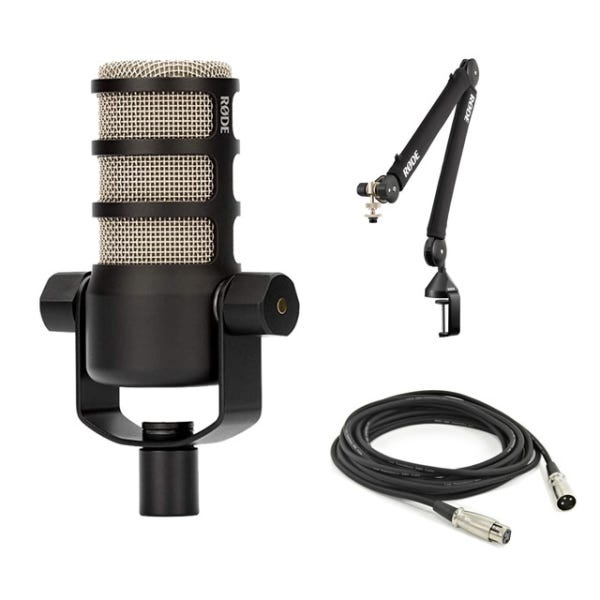
Broadcast Dynamic Cardioid Capsule, 20 Hz – 20 kHz Frequency Response, 320 Ω Output Impedance, Internal Pop Filter, Internal Shockmount, Integrated Swing Mount, XLR Output, No Phantom Power Required, All-Metal Body with Stainless Steel Grille, 37″ Horizontal Reach, 34″ Vertical Reach, 94g–1.2kg Load Range, Silent Parallelogram Spring Mechanism, Integrated Internal Cable Management, Desk Clamp up to 70 mm + Threaded Desk Insert up to 55 mm, 3/8″ to 5/8″ Thread Adaptor, Matte Black Powder Coat, 10-Foot Balanced XLR Cable (Male-to-Female, Common-Mode Rejection)
This bundle pairs the Rode PodMic with the boom arm Rode built to hold it. The PSA1+ is the company's flagship studio arm: silent parallelogram spring mechanism, integrated internal cable management, 94 g to 1.2 kg load range, and a 37-inch horizontal reach. It's the same arm broadcasters and professional podcasters mount the Shure SM7B on. Paired with the PodMic in this bundle, you get the matched signal chain Rode engineered as a single product family — and a balanced 10-foot XLR cable to wire the chain to your audio interface. One purchase. One brand-matched recording setup. The upgrade path for the podcaster who's done buying cheaper arms.
Condenser microphones are extraordinarily sensitive — which is what makes them the right choice in a treated studio and the wrong choice in your apartment, bedroom, or shared office. The PodMic's dynamic capsule needs you closer to the diaphragm to drive it, and that proximity is the feature, not the limitation. Speaking 1 to 4 inches off the grille fills your voice with low-end warmth and lets the cardioid pattern do its job: anything off-axis to the front is attenuated. The keyboard, the fan, the air conditioner, the dog — none of it makes it into the recording. The 320 Ω output impedance feeds standard interface preamps with healthy headroom — louder and easier to drive than the Shure SM7B at a fraction of the price.
The PodMic is engineered as a complete package. The dual-mesh housing acts as the pop filter — plosives are absorbed before the capsule hears them, so the recording stays clean on close-mic P and B consonants without a gooseneck pop screen blocking the on-camera shot. The capsule is internally suspended on the swing mount; the swing mount is internally decoupled from the body. Desk thumps, mouse clicks, and arm-adjustment handling noise stay out of the audio.
Cheap arms expose their tension springs and let them ring like a triangle every time you reach up to adjust the mic. The PSA1+ uses a parallelogram linkage with sleeved internal springs decoupled from the metal — repositions silently at any angle without spring creak, twang, or friction shudder during a take. For a podcaster recording 90-minute interviews and adjusting the mic between segments, this is the difference between a usable continuous recording and a session full of edit points. The cardioid pattern below catches every metal-on-metal noise from a cheaper arm; the PSA1+ doesn't make any.
The XLR cable routes through a removable channel along the spine of each arm segment, exits at the back of the base, and runs to the interface without ever showing on camera. No cable clips, no spiral wrap, no zip ties holding cable to chrome metal. For streamers and podcasters running a face-cam over the mic, this is the visual difference between a professional set and a desk full of wires. Removable channel covers let you re-route the cable when you swap mics or interfaces. The included 10-foot SSAV-MIC-10 balanced XLR runs neatly inside the arm and out to your interface.
The PSA1+ holds anything from a 94-gram USB condenser up to a 1.2-kilogram dynamic broadcast mic. That range covers the Rode PodMic (865 g), the Shure SM7B (765 g), the Rode NT1 Signature (376 g), the Rode PodMic USB, and every common podcasting microphone on the market. Cheaper arms top out at 1.5 lb (~680 g) and start to droop with the PodMic. The PSA1+ doesn't. The springs hold position cleanly even at full extension under the heaviest load, and the 37-inch horizontal reach + 34-inch vertical reach gives more positioning range than any compact arm.
Out of the box, the PSA1+ ships with both a desk clamp (fits desk edges up to 70 mm / 2.75″) and a threaded desk insert (fits desks up to 55 mm / 2.16″) for buyers who want to drill a permanent mount through the desk surface. The clamp is the default for most setups — it works on glass desks, particleboard desks, and standing desks alike, and removes in seconds for relocation. The threaded insert is the broadcast-studio choice for permanent installations where the arm needs to live in one place for years.
The PodMic outputs over XLR. The interface inputs are XLR. The cable in between has to be balanced and the right length — too short and you can't route around your desk, too long and you're coiling slack into the recording space. The SSAV-MIC-10 is 10 feet of balanced 3-pin XLR cable, male-to-female, with full shield and common-mode rejection that eliminates hum, buzz, and RF interference from the signal path. Long enough to route through the PSA1+'s internal cable channel and back to a desktop interface. Short enough not to coil.
For the podcaster whose first arm sagged under the PodMic and squeaked when they adjusted it. For the streamer who wants the matched Rode aesthetic on a face-cam set. For the broadcaster running daily live reads who needs the silent reposition during a take. For the home studio owner upgrading from a tabletop stand to a real arm. And for the SM7B comparison shopper who realizes the PodMic plus the PSA1+ together cost less than the SM7B alone — and the PodMic is louder, easier to drive, and arrives with the broadcast-studio arm Rode designed for it. Sit down. Plug in. Record in silence.
| MPN | PodMic, PSA1+, XLR, Cloth |
|---|---|
| Color | Black |
| UPC / EAN | 656485269083 |
| Brand | Rode |
| Product Condition | New |
| Availability | In Stock |

| Microphone Type | Dynamic, Cardioid Broadcast |
| Frequency Response | 20 Hz – 20 kHz |
| Output Impedance | 320 Ω |
| Output Connection | 3-pin XLR, Balanced (No Phantom Required) |
| Pop Filter and Shockmount | Internal — Built Into Body |
| Microphone Weight | 865 g (1.9 lb) |
| Boom Arm Reach | 37″ Horizontal × 34″ Vertical |
| Boom Arm Load Range | 94 g – 1.2 kg (3.3 oz – 2.6 lb) |
| Spring Mechanism | Parallelogram, Silent — Sleeved Internal Tension Springs |
| Cable Management | Integrated Internal Routing |
| Desk Clamp Capacity | Up to 70 mm (2.75″) Desk Edge |
| Threaded Desk Insert | Up to 55 mm (2.16″) |
| Arm Finish | Matte Black Powder Coat |
| XLR Cable | 10 Feet — Balanced 3-Pin, Male-to-Female |