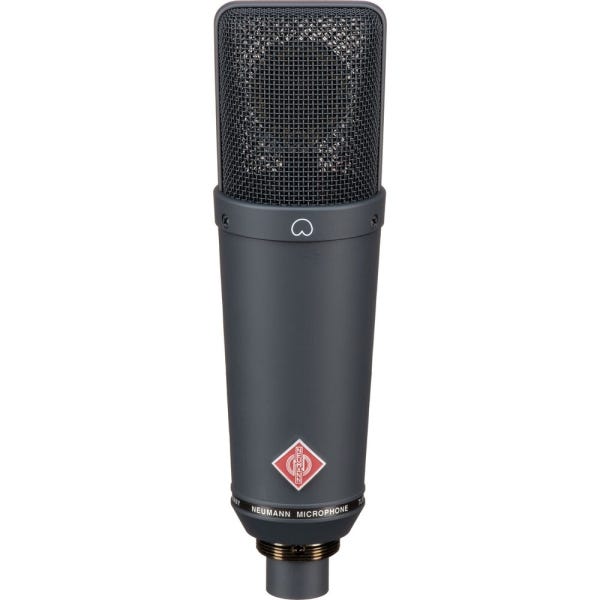
Large-Diaphragm Cardioid Condenser Microphone, Fixed Cardioid Pattern, 10 dB-A Self-Noise, 140 dB Max SPL, Switchless Plug-and-Play Design, 48V Phantom Power
This original Neumann product is covered by a warranty of 24 months. The warranty period begins on the date of purchase of brand new, unused products by the first end user.
The Neumann TLM 193 is a large-diaphragm cardioid condenser microphone with a switchless, plug-and-play design for engineers who want a reference sound with no decisions to make. There is no pattern selector, no pad, and no low cut, just a single uniform cardioid to aim at the source. That simplicity is deliberate: it puts a genuine Neumann reference capsule in a body with nothing to set wrong. The result is a sound image very close to what the ear hears in the room. It is the Neumann to reach for when the job is simply to capture the source honestly.
Technically the TLM 193 is a streamlined, cardioid-only version of the acclaimed TLM 170 R, and it uses the very same K 89 large-diaphragm capsule. That shared capsule gives it the 170 R's linear response on- and off-axis, minus the multipattern switching and pad. In effect it distills the reference microphone down to its most-used pattern at a simpler operating point. Engineers who know the 170 R's neutrality will recognize it here in fixed cardioid form. It is reference DNA in a single-pattern package.
Because the cardioid pattern is exceptionally uniform, off-axis sound arrives with the same tonal character as on-axis sound. That means a source and its ambience are captured truthfully rather than filtered through a coloration, which is unusual for a fixed-cardioid mic. The pattern rejects sound from the rear, favoring the source in front and controlling room reflections. On a voice or an instrument, the off-axis honesty keeps the natural character intact. Aim it and record, since the pattern does the rest without a switch to second-guess.
TLM stands for transformerless microphone, and the 193 replaces the traditional output transformer with an electronic output stage. Removing that component takes coupling losses out of the path for an immediate, uncolored sound and a bass response that stays solid at high levels. The balanced XLR output still drives long cable runs cleanly to a preamp or console. It is the same output philosophy that runs through the entire TLM line. On a vocal, the payoff is a clean, present track that needs little help downstream.
Self-noise of just 10 dB-A sits below the ambient noise of even a quiet studio, so soft detail reaches the recording without hiss. The mic handles up to 140 dB SPL with no pad switch, and its 130 dB dynamic range lets it track a whispered line and a loud source without artifacts. A maximum output of 13 dBu keeps the signal healthy into any preamp. That window between the noise floor and clipping is wide enough for both delicate and full-scale sources. Quiet passages and loud transients are both handled without a setting to change.
What you hear is what you get: the neutrality of the K 89 capsule and the transformerless circuit combine to reproduce a source with very little editorializing. There is no presence hype to flatter a thin voice and no scoop to hide a dull one, since the mic simply tells the truth. That honesty makes it a superb choice for vocals and speech, and especially for dubbing and voice-over where the authentic voice character has to survive intact. For a project or broadcast studio, it is a lot of Neumann quality in a very simple package. It rewards a good source and a good room rather than masking either.
Beyond voice, the 193's clean and even response suits acoustic and electric guitar, drums and percussion, and piano. Its uniform cardioid makes it a dependable spot mic in an orchestral setting on low strings, woodwinds, or brass, capturing a section without dragging in the whole stage. It is designed mainly for home, project, and broadcast studios, yet it slots into a larger room as an extra pair of trustworthy ears. The lack of switches makes it fast to deploy when a session is moving quickly. Few single-pattern mics are this versatile in practice.
The slim 49 mm body and dark finish let the TLM 193 disappear as a spot mic on a crowded stage, unobtrusive where a larger mic would intrude. It ships with the SG 2 swivel mount and a protective wooden box, so it is ready for a stand straight out of the case. The mic runs on 48 V phantom power over a balanced XLR 3-pin output, fitting any interface, console, or preamp. Built in Germany, it is engineered for years of dependable studio service. It suits the engineer who wants Neumann reference sound in a fixed-cardioid mic with nothing to configure.
| MPN | 008381 |
|---|---|
| Color | Black |
| Element | Condenser |
| Pattern | Cardioid |
| Power Source | 48V Phantom Power |
| Form | Large-Diaphragm Condenser |
| Output | XLR |
| UPC / EAN | 615104083813 |
| Brand | Neumann |
| Product Condition | New |
| Availability | In Stock |
| Acoustic Operating Principle | Pressure Gradient Transducer |
| Directional Pattern | Cardioid |
| Capsule | K 89 Large-Diaphragm |
| Frequency Range | 20 Hz – 20 kHz |
| Sensitivity | 18 mV/Pa |
| Self-Noise (A-weighted) | 10 dB-A |
| Signal-to-Noise Ratio (A-weighted) | 84 dB |
| Maximum SPL (0.5% THD) | 140 dB |
| Dynamic Range | 130 dB |
| Maximum Output Voltage | 13 dBu |
| Powering | 48 V Phantom Power (P48) |
| Output Connector | XLR 3-Pin (XLR 3 F) |