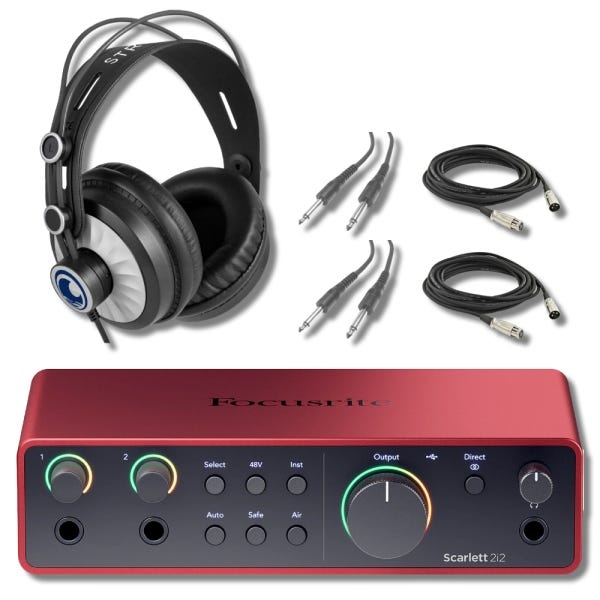
24-Bit/192kHz USB-C Conversion, 120 dB Dynamic Range, 2 x Combo XLR/TRS Inputs with 69 dB Gain Range, Air Mode with Presence + Harmonic Drive, Auto Gain, Clip Safe (96,000 Checks/Sec), 50mm Closed-Back Studio Headphone Drivers, 32-Ohm Impedance, 15Hz–25kHz Frequency Response, 1/4-Inch Adapter Included, 10-Foot Balanced XLR Cable, 25-Foot Balanced XLR Cable, Twisted-Pair Common-Mode Noise Rejection, Bus-Powered USB-C
The Scarlett 2i2 (4th Gen) is the audio interface Focusrite built for the recordist who plugged in a USB mic last year and is ready for the real signal chain — and this bundle wraps it with everything missing from the retail box. The interface alone gets you 24-bit/192kHz conversion, 69 dB of preamp gain on two combo XLR/TRS inputs, Auto Gain that sets the level for you, Clip Safe that pulls gain back before clipping ruins the take, and Air mode that adds analog-style brightness. The kit adds the StreamEye Cans50 closed-back studio headphones for tracking and monitoring, a 10-foot SSAV-MIC-10 balanced XLR cable for the desk-side mic-to-interface run, and a 25-foot Calrad 55-675-25 balanced XLR cable for the vocal-booth or live-room run. One purchase, four components, monitoring chain wired end to end.
Two features on the 4th-Gen Scarlett 2i2 change the recording learning curve. Auto Gain listens to a 10-second test pass and sets the input gain to the optimal level for the connected microphone — no more guessing whether the knob is at 11 o'clock or 1 o'clock, no more clipped first take when the singer goes for the chorus and the engineer didn't ride the trim. Clip Safe runs in parallel: it samples the input 96,000 times per second and pulls the gain back the moment it detects an imminent over. Dynamic Gain Halos around each input flash red when clipping is close. The result is a session that feels like working with a producer who keeps the levels honest — for an engineer still learning what the levels should be.
Air mode is the Scarlett 4th-Gen's bid to bring a piece of analog console character into the budget interface category. Pressing Air on a channel layers in either Presence (a high-shelf brightness modeled on the original ISA preamp) or Harmonic Drive (a saturation curve that adds even-order harmonics for warmth and weight) — or both at once, per channel. On a large-diaphragm condenser vocal, Air Presence brings forward the consonants. On an acoustic guitar pair, Air Harmonic Drive adds the body that compresses out at low levels. Two channels can each carry a different Air setting, so a vocal and an acoustic recorded together each get the polish that suits them.
The 2i2's 1/4-inch headphone output has its own gain stage and its own level knob, separate from the monitor outputs that feed the studio speakers. That sounds like a minor detail until you try to track a vocal on an interface where the headphone level is tied to the monitor mix — every time the talent asks for more mic in the cans, the room speakers also get louder. The 2i2's independent output ends that. Drive the Cans50 to tracking level for the singer while the monitors stay quiet, and switch to monitor playback for the engineer position without re-balancing the cans.
The Cans50 included in this bundle is a closed-back circumaural studio headphone with 50mm dynamic drivers, a 15Hz–25kHz frequency response, 32-ohm impedance, and 95 dB/mW sensitivity. The closed-back design provides passive isolation — it blocks the room without electronic noise cancellation, which means it doesn't bleed click track or backing tracks into the vocal mic during tracking. The 90-degree fold-flat earcups pack into the included soft headphone bag for travel or storage in a gear case. A 1/4-inch adapter is in the box, so the headphones plug straight into the 2i2's quarter-inch jack with no adapter to source. For mixing and reference, the wide frequency response and closed-back isolation make them a workable monitoring pair when full-range speakers aren't an option.
The kit ships with two balanced 3-pin XLR cables sized to the two recording distances most engineers face. The 10-foot SSAV-MIC-10 is the desktop run — mic on a boom arm or stand at the desk, cable to the interface a few feet away. The 25-foot Calrad 55-675-25 is the vocal-booth or live-room run — singer in the iso booth, interface in the control room, 25 feet of cable bridging the gap. Both cables are balanced male-to-female with twisted-pair shielded conductors, so common-mode noise rejection cancels electrical interference and RF pickup across the full run. No hum, no buzz, every position from the desk to the far wall covered.
The signal path is end-to-end wired. A microphone plugs into either the SSAV-MIC-10 (for the desk) or the Calrad 55-675-25 (for the booth or far position), the cable runs to the 2i2's combo XLR/TRS input, Auto Gain sets the level, Air mode shapes the tone, and the Cans50 headphones plug into the 1/4-inch headphone jack for zero-latency tracking. Switch to playback monitoring from the same headphones during overdubs and mix reference. The kit covers every link in the chain — interface, monitoring, two cable lengths — without forcing the buyer to leave the order page to find compatible parts.
For the first-time recordist who needs an interface and doesn't want to discover at unboxing that headphones and cables aren't in the retail box. For the singer-songwriter or podcaster moving from a USB mic to a real XLR signal chain who needs both a desktop cable and a longer cable for vocal-booth tracking. For the producer adding a second interface to a studio rig who wants the monitoring and cabling sorted in one purchase. Plug in. Track. Mix.
| MPN | Scarlett 2i2 4G, Cans50, 55-675-25, XLR |
|---|---|
| Color | Red |
| UPC / EAN | 345629729124 |
| Brand | Focusrite |
| Product Condition | New |
| Availability | In Stock |

| Interface Type | USB-C Audio Interface, 2-In / 2-Out |
| Conversion | 24-bit / 192 kHz, 120 dB Dynamic Range |
| Preamps | 2 x Combo XLR/TRS, 69 dB Gain Range |
| Air Mode | Presence + Harmonic Drive, Per Channel |
| Auto Gain / Clip Safe | Yes — 96,000 Checks/sec Clip Safe |
| Outputs | 2 x Balanced 1/4″ TRS Monitor + 1/4″ Headphone |
| Bus Power | USB-C, No External Power |
| Headphone Driver | StreamEye Cans50 — 50mm Closed-Back, 32 Ω, 15Hz–25kHz |
| Headphone Sensitivity | 95 dB/mW, 1200 mW Max Input |
| Short XLR Cable | SSAV-MIC-10 — 10 Feet, Balanced 3-Pin, Male to Female |
| Long XLR Cable | Calrad 55-675-25 — 25 Feet, Balanced 3-Pin, Male to Female |