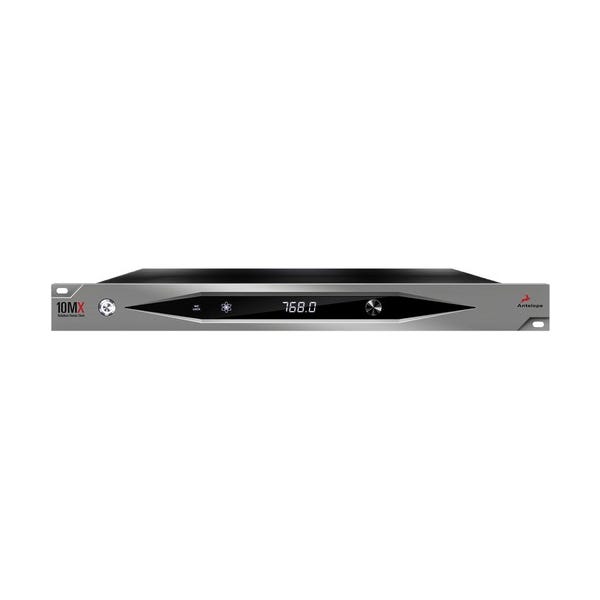
Rubidium 10 MHz Atomic Reference, 4th-Gen 64-Bit AFC Clocking, Ten 10 MHz BNC Atomic Outputs, Four Word Clock Outputs to 768 kHz, Two AES/EBU and Two S/PDIF Outputs, ±0.05 PPB Frequency Accuracy, Oven-Controlled Stability, USB Control, 1U Rackmount Chassis
The Antelope Audio 10MX is a rubidium atomic master clock that houses a physics-grade 10 MHz oscillator in a single 1U (1.75-inch) rack space. It delivers a reference accuracy better than +/-0.05 parts per billion, giving your converters a timing source so stable that jitter effectively drops out of the equation. Built around Antelope Audio's fourth-generation 64-bit Acoustically Focused Clocking, it distributes atomic-grade timing to as many as ten devices at once. This is the clock a mastering room buys once and never questions again, the quiet backbone every great recording is timed against.
At the heart of the 10MX sits a rubidium oscillator, the same class of atomic reference used in scientific and telecom timing, rated better than +/-0.05 PPB accuracy at 77 F. A rubidium standard works by locking its oscillation to the natural resonance frequency of rubidium atoms, a constant of physics that does not drift with temperature, age, or line voltage the way a quartz crystal does. In practical terms this means your entire digital chain is anchored to a reference thousands of times more stable than the internal clock of any converter. For a mastering engineer chasing the last increment of depth and stereo focus, that rock-solid foundation is what lets subtle detail survive intact all the way to the final file.
The 10MX provides ten BNC outputs delivering a 10 MHz atomic signal on 75-ohm lines, enough to feed up to ten separate devices from a single source. A 10 MHz atomic output is not a word clock; it is a raw physics reference that compatible converters and clocks lock their own internal timing to, inheriting the rubidium stability upstream. Because every device in the room references the same atomic heartbeat, the phase relationships between multiple converters stay locked and consistent. In a large tracking or mixing facility running stacks of converters, this eliminates the timing smear that creeps in when each unit free-runs on its own crystal.
Beyond its atomic outputs, the 10MX carries four 75-ohm BNC word clock outputs running from 44.1 kHz all the way to 768 kHz, plus two AES/EBU (XLR) and two S/PDIF (RCA) digital outputs up to 192 kHz. Word clock is the sample-level timing pulse that tells each converter exactly when to capture or reproduce a sample, and driving it from one master keeps every device sampling in perfect lockstep. The additional AES/EBU and S/PDIF outputs let you clock gear that has no dedicated word clock input directly from the master reference. This breadth means a single 10MX can serve as the central timing hub for a mixed rack of legacy and modern converters without add-on distribution boxes.
Antelope Audio's fourth-generation Acoustically Focused Clocking uses a 64-bit Direct Digital Synthesis engine paired with an oven-controlled crystal oscillator to shape the outgoing clock signal. Jitter is the tiny timing uncertainty between clock edges, and even picoseconds of it translate into audible noise and a loss of stereo detail when a converter samples at the wrong instant. The AFC algorithm continuously measures and corrects the clock so that the atomic accuracy of the rubidium reference is preserved all the way to each output rather than being degraded by the circuitry. What an engineer hears is tighter transients, deeper and more stable imaging, and a background that stays genuinely black.
The 10MX oven-controls its oscillator at a constant 148 F, holding stability tighter than +/-0.02 PPM regardless of what happens to the ambient temperature around it. An oven-controlled crystal oscillator, or OCXO, seals the timing crystal inside a temperature-regulated chamber so the reference frequency does not wander as a studio warms up over a long session or cools overnight. This matters because temperature is the single largest source of drift in a conventional clock, and drift shows up as slow pitch and timing instability across a multi-hour project. After an eight-to-ten-minute warm-up, the 10MX settles into a reference you can leave running for years and trust every single day.
The 10MX operates across a sample-rate span from 32 kHz to 768 kHz and accepts an external word clock input on BNC from 44.1 kHz to 384 kHz. That input lets the 10MX slave to an external house reference when a facility already runs a plant-wide sync, so the atomic clock integrates into an existing infrastructure rather than fighting it. Supporting rates up to 768 kHz future-proofs the unit for high-sample-rate mastering and archival work where the extra headroom in the digital domain is genuinely used. Whether you track at 96 kHz today or move to high-rate formats tomorrow, one master clock covers the full professional range.
Every clocking parameter on the 10MX can be set from the front panel or from Antelope Audio's control software over a USB 2.0 Type-B connection, which also handles firmware updates. USB control means an engineer can configure output rates, monitor lock status, and recall setups from the computer without reaching behind the rack, and firmware updates keep the unit current as new features arrive. This is especially valuable in an installed system where the clock lives in a machine room away from the mix position. Setup becomes a one-time task you save and recall, so the 10MX simply works the moment you power up.
| MPN | 10MX |
|---|---|
| Color | Silver |
| Input | BNC Word Clock |
| Power Source | AC Mains |
| Form | Master Clock |
| Output | BNC Word Clock |
| UPC / EAN | 853744004311 |
| Brand | Antelope Audio |
| Product Condition | New |
| Availability | Out of Stock |

| Reference | Rubidium 10 MHz ultra-stable oscillator |
| Frequency Accuracy | better than +/-0.05 PPB @25C |
| Stability | < +/-0.02 PPM, oven controlled 64.5C |
| Clocking | 4th-gen 64-bit AFC, DDS, OCXO |
| Atomic Outputs | 10x BNC 10 MHz, 75 Ohm (clocks up to 10 devices) |
| Word Clock Outputs | 4x BNC 75 Ohm, 44.1 kHz - 768 kHz |
| Word Clock Input | 1x BNC 44.1 - 384 kHz |
| Additional Outputs | 2x AES/EBU (XLR), 2x S/PDIF (RCA), up to 192 kHz |
| Sample Rates | 32 - 768 kHz |
| USB | USB 2.0 Type-B for control/firmware |
| Warm-Up | 8-10 minutes |
| Power | 100-240V, ~15 W |